
Klara and the Sun
Recently, I have been slowly getting back into the habit of engaging with relatively more traditional pastimes, one of which is reading; don't get me wrong, I do plenty of reading in my life, most notably in my professional life where reading documentations is an important part of learning, but there is something different about reading for leisure wherein the experience centers around contemplation, reflection and the inner world as opposed to something purely factual or goal-driven.
So it is just a touch ironic that I got the opportunity to read this little book, Klara and the Sun by Kazuo Ishiguro by chancing upon it via my employer's community library in the officeNote
It calls for some contemplation on supportive environments in our careers that allows for professional and personal growth, for which I am grateful; but that is a conversation for another time.
. For this post, it is simply about my thoughts on some of the subjects this book touches upon, as a casual review of sorts. This is a spoiler-free review, with only minor allusion to parts of the story which should not affect your experience should you decide to pick this book up after reading this post.
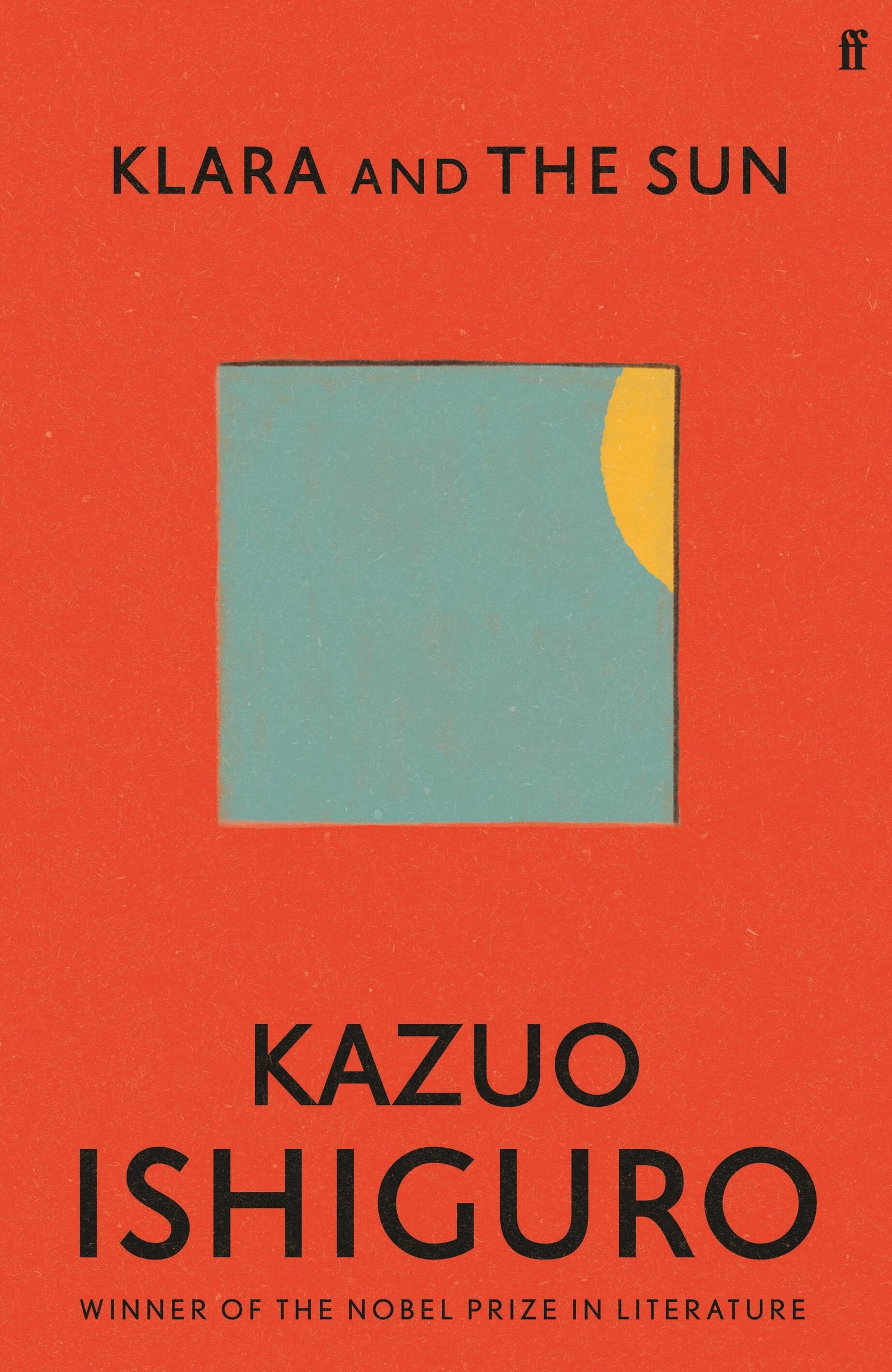 The paperback cover of the book, designed by Pete Adlington. Source: Spine
Klara and the Sun tells a story of a family in a future with "Artificial Friends"; it begins with a descriptive chapter from the perspective of Klara, an Artificial Friend (AF) who has been put up for sale in an AF store downtown. I was particularly intriqued by the unique way ordinary objects and occurrences were described by the narrator Klara, and the perspective from a non-human (yet human-like) entity made for an interesting and endearing experience.
Klara is eventually bought by a sickly girl, Josie and her mother. She provides Josie company and learns from her, and eventually integrates into the household. Much of the story revolves around Josie's condition, how it affected the people around her and Klara's own internal interpretation of the events.
“ 'Sometimes', she said, 'at special moments like that, people feel a pain alongside their happiness.' ”While the book is futuristic in nature (it has also been described as dystopian), a prospective reader might like to know that this is not exactly a "sci-fi" story that materializes technology's evolution with grand arching narratives on society. Rather, it is a book about normal people (and entities like Klara) and how their most intimate aspirations and dreams manifest in such a setting. In that sense, despite the subject being about Artificial Friends, it is a deeply human book.
Characters
Klara
The narrator and main character of the book. An Artificial Friend who was described by the shop owner as a little different from the others due to her sagacity. With her goal of fulfilling the needs of her owner (Josie), Klara learns from the family members around her, making note of dynamics surrounding the people in an unusual manner.
“Do you believe in the human heart? I don’t mean simply the organ, obviously. I’m speaking in the poetic sense.”Klara as the voice of the story contributed a lot to my enjoyment of the book. At times, Klara behaved in a very calm and warm way that put people at ease; yet in other moments, her perspective and description when encountering new experiences was almost child-like. Reading this juxtaposition of an adult-like, professional manner and speech with a juvenile inner world of a learner felt very delicate.
Josie
A sickly girl who is under Klara's care and companion. We see her daily life and her growing pains as she fights her illness, although the true nature of her illness is only implied in the book.
While Josie is a central character in the book, a lot of ideas are explored through the people around her and her condition. In contrast to Klara, Josie embodies the ideals of a pure child without the premonition or sentient analysis of events around her. If anything, Josie almost represents something Klara could never become, even if their places were swapped, due to Klara's nature and inclinations.
The Mother
Josie's mother, who made the decision to let Klara be Josie's companion. The Mother is a very interesting character whose motives seemed to be rather clear at the start, but we see that evolving over time as the story progresses.
The mother's portrayal illustrates the conflicts between the capabilities of the dystopian future, and the sensibilities of what makes us human. I find it most ironic how the most human factors seem to drive us to seek out remedies, remedies of a nature whose essence of "human" is unclear.
Rick
Josie's childhood friend, and one of the "unlifted" as described by the characters in the book. Rick was portrayed as a contrast to the other kids, as someone who chose not to go on a pre-destined path set by the system.
Similar to the Mother, Rick presents to us a deliberation on the nature of talent; what is natural and what is not, and what should be extent of endorsement given to artificial means of enhancing it?
“It couldn’t have worked out, me going to college, trying to compete with all those lifted kids.”Even today, one's talents are viewed not simply as some pure quality, but through quantifiers that likely represent the composite of intrinsic qualities and external factors (living environment, opportunities given in life, etc.). So where do we draw the line?
The Sun
A common appearance within Klara's internal monologue was the Sun, a figure (or object) that is revered in an almost spiritual manner by Klara. Klara tries to makes sense of phenomena she did not fully understand, giving the Sun a role based on her own conjectures.
“In the morning when the Sun returns.It’s possible for us to hope.”
It is rather apt that Klara is a solar-powered AF.
Closing Thoughts
There's a lot more I could pen about this book, such as the ending which might be polarizing, but I think I have written enough here to give some insights what the book entails. The setting may be dystopian, with plenty of hints at subject matters in grey areas, and yet, reading this book has been a very peaceful, beautiful and almost sweet experience.
It gave me a good opportunity to reflect on my own upbringing and privilege, the enduring march of time and the inevitability of a 'slow fade' in many aspects of our lives come and gone.
Perhaps, many years later, this same feeling will return, about many things today that I am blissfully unaware of. But I certainly hope that I will be able to notice and appreciate the smaller, ordinary facets of life more after reading this book.
NoteAll content on this page is 100% crafted and penned by a human.